Medical Equipment Covers: What OEM Buyers Must Check
Medical equipment covers look like a small line on the catalogue. For manufacturers and distributors of beds, wheelchairs, examination tables, and carts, they are the difference between equipment arriving clean or arriving scratched, dusty, and ready for a complaint.
Unlike a consumer cover, a medical cover has to hold up to repeated washing, regular handling, and transport between facilities. The spec sheet matters more than the look.
Why Medical Equipment Covers Are a Separate Category
A cover for a patient bed is not a scaled-up patio cover. It protects equipment that moves between wards, between facilities, and into long-term storage. It gets pulled on and off by staff who need speed, not patience.
The category splits into two jobs. Transport and storage covers keep beds, wheelchairs, and carts clean between delivery points. Hygiene-focused covers sit on equipment that must stay presentable in a care environment. Both jobs reward a cover that is easy to clean and hard to damage.
The equipment list is wider than most buyers expect: hospital beds, wheelchairs, examination tables, physio benches, medication carts, and patient transfer equipment. Each shape brings its own measurement challenge. A bed cover is a large flat envelope. A wheelchair cover has to clear handles, brakes, and armrests. A cart cover needs openings for drawers that staff open throughout the day.
Fabric and Finish: What to Specify
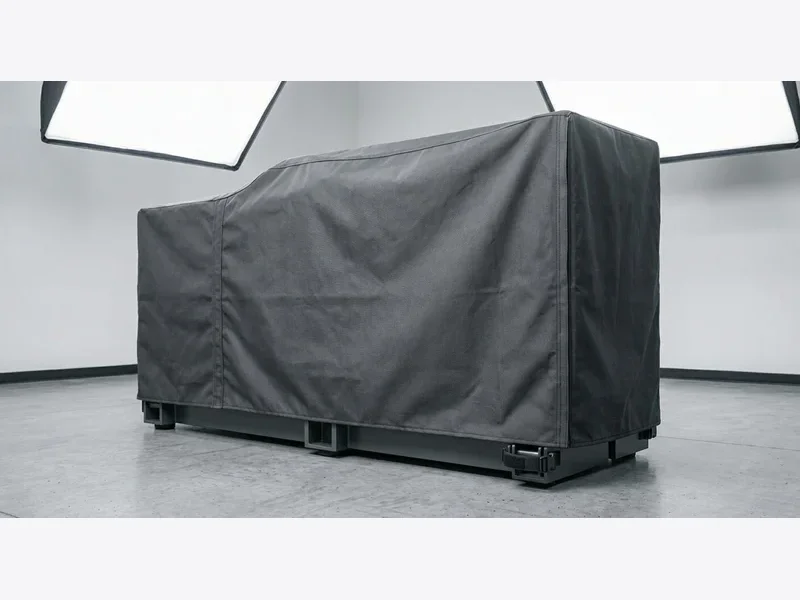
PVC-coated polyester is the common starting point. It wipes clean, resists water, and survives the abrasion of repeated handling. For equipment stored indoors, breathable fabrics reduce the moisture buildup that leads to mildew.
Washability is the spec most buyers underrate. Ask how many wash cycles the fabric and seams survive, and how the cover dries. Seam tape on the inner seams keeps water and dirt out of the stitching.
Finish options turn a plain cover into a branded one. Embroidered logos, printed labels, and label pockets for serial or model numbers are all standard OEM work. For buyers distributing under their own brand, the cover becomes part of the product, not an afterthought.
Fire-retardant treatment should be specified only when the buyer's requirements demand it. Do not assume a standard fabric meets a particular facility standard. Confirm the requirement in writing, then confirm the material against it.
Fit and Closures: The Part That Fails in Use
Universal covers sell, and then they disappoint. A bed rail sticks out, a control panel is buried, a wheelchair handle tears the fabric on the way in. Made-to-measure covers from the exact model dimensions avoid every one of these complaints.
A cover that fits well stays on. A cover that fights the user gets left off. In care settings, staff will always choose speed over protection, so design for the person who puts the cover on, not just the person who buys it.
Access flaps matter for anything with controls, handles, brakes, or poles. A flap that opens where the staff needs it keeps the cover on the equipment instead of on the floor.
Closures are a checklist on their own: zippers, Velcro panels, and elastic hems each suit different equipment. Reinforce corners, handles, and stress points, and keep drawstring channels wide enough for the cord specified in the drawing.
What to Check With a Supplier Before Ordering
- A spec sheet that lists fabric weight, coating, seam construction, and closure types.
- A pre-production sample matched to the exact model, not a similar one.
- A wash test: how the cover holds after repeated cleaning cycles.
- Packaging that keeps covers folded clean and labeled for delivery or retail.
- MOQ and lead time aligned with your reorder cycle, not your launch date.
Apply the same sample discipline you would to any OEM part. The approved sample is the contract. Every production unit should match it, from fabric lot to stitch density.
For the wider picture on fabric durability, see our heavy duty equipment covers guide and the eco-friendly materials guide. If your covers are part of a transport and storage program, the transportation and storage covers guide covers the same questions for industrial equipment.
Frequently Asked Questions
What fabric is best for medical equipment covers?
PVC-coated polyester is the common choice for water resistance and easy cleaning. Breathable options suit equipment stored indoors where moisture buildup is a concern. The right choice depends on the equipment, the environment, and the washing routine.
Can covers be made to fit a specific bed or wheelchair model?
Yes. Covers are made to measure from the exact model dimensions, with access flaps for controls, handles, and poles. This is where a custom OEM supplier differs from a universal-cover importer.
Need Covers for a Specific Medical Equipment Line?
Send us the model list and we will share material samples and a spec sheet.
Request Material Samples